Dear all,
Following Bidi's request, I fixed a way to embed music on the blog. Below, you will find an example of how it works (please comment below if you cannot hear the music or see the player. If you don't it's most probably that you need to install the Quicktime plugin for your browser). I picked something short and uncopyrighted for starters. Anyway, since we all only buy legal music on iTunes™ and the blog is private to us, I'm sure there will be no major problems with that.
Keep this option in mind when writing your story, in case you want to add music.
Unless you know how to host an .mp3 (or .m4a if coming from iTunes™) file on a hosting website (ad ex. here), you will have to send the music file to me™, and I'll put it on.
Thanks to all the BA students for the interesting conversations of today (and I'm sure you MA students did great too...).
I'll soon send a collective email to make it clearer who is in which timeslot for the tutorials. Please respect them next week, so we can have a good number of people in both.
Thursday, 23 October 2008


Horkheimer and Adorno
Now that you have all read Horkheimer and Adorno you may like to take a look at this extract from an article that unpacks it a little. But is this all we can say about their relationship to myth in 'dialectic of Enlightenment'? What does the context of the time they were writing add to our understanding of their critique of myth of Enlightenment?
Sunday, 19 October 2008
MA tutorial group activity - negative group
The MA's were divided into two groups this week to play around with the idea of self representation in language and how 'myths' can be created using similar language but for very different purposes. Perhaps an illustration of the ways in which meaning is created through interpretation both by 'creator' and reader:
The religionists in the MA course have a very narrow specialisation (with a focus particularly on dead-languages) for the purposes of examinining diverse and heterogeneous phenomenons which become universalised and totalised under their 'objective' gaze. The discipline of which they are a part is closed and does not engage with discourses going on outside of their specialisation, preventing the authority of their discipline from coming under scrutiny.
I hope that the other group blogs theirs up soon, as otherwise this looks like some random abuse of all you SoR bods ;-p
The religionists in the MA course have a very narrow specialisation (with a focus particularly on dead-languages) for the purposes of examinining diverse and heterogeneous phenomenons which become universalised and totalised under their 'objective' gaze. The discipline of which they are a part is closed and does not engage with discourses going on outside of their specialisation, preventing the authority of their discipline from coming under scrutiny.
I hope that the other group blogs theirs up soon, as otherwise this looks like some random abuse of all you SoR bods ;-p
Friday, 17 October 2008
Extra readings for Critical Theory/Myth & Mythmaking
Click here for link to the list. I will update this list regularly as and when I remember or find more titles. Please add any more that you come across.
Nb. The Bookshop that i have recommened, Bookmarks, the Socialist Bookshop, is a small independent bookshop fighting it's way against the big, bad, meany multi-nationals; (correct use of a semi-colon?!) most of which have decreased stocks of academic books, especially the not-so-mainstream variety due to the fact that they're not 'bestsellers'.
The lovely, knowledgable workers will help you find what you are looking for, and perhaps suggest titles that you didn't know you are looking for. They can order ANY book, even capitalist stuff if you like...
If you set up an account and direct debit of £10 per month you get 10% off. It's great coz when you go in to get books it feels like you're getting free books! They also do many events; book launches with great speakers, filmshowings, parties and the such like. Enjoy.
In solidarity, Clare
Nb. The Bookshop that i have recommened, Bookmarks, the Socialist Bookshop, is a small independent bookshop fighting it's way against the big, bad, meany multi-nationals; (correct use of a semi-colon?!) most of which have decreased stocks of academic books, especially the not-so-mainstream variety due to the fact that they're not 'bestsellers'.
The lovely, knowledgable workers will help you find what you are looking for, and perhaps suggest titles that you didn't know you are looking for. They can order ANY book, even capitalist stuff if you like...
If you set up an account and direct debit of £10 per month you get 10% off. It's great coz when you go in to get books it feels like you're getting free books! They also do many events; book launches with great speakers, filmshowings, parties and the such like. Enjoy.
In solidarity, Clare
Next Week


The tutorial question for next week is:
What is the ‘dialectic of Enlightenment’ and what are its main characteristics? What ‘myth of Enlightenment’ are Adorno and Horkheimer challenging in this article? What and whose purpose might that myth serve? What might be at stake in maintaining it as the foundation of western rationality? Whose myth is it?
Keep in mind some things:
1) The article refers heavily to the Odyssey, which by now you should know like the back of your hand.
2) Read it critically: by now you should have enough theoretical background on myth, progress and interests in myth formation (courtesy of Sian's lectures) to spot the subtext and the expectations that underlie the paper.
3) Keep in mind who the guys who wrote that paper are (Theodor W. Adorno and Max Horkheimer) hence what they might be aiming at.
Above you see two pics of the two in question: Horkheimer above and Adorno below (what is it with bald philosophers?)
Power
Since we've been talking about power and politics quite a lot last time (and about power structures in the educational system), these two videos might interest you. It is always good to see 'great philosophers' in real life, as human beings. Do comment here, or else we can discuss it next time in the tutorial.
Which of the two 'great minds' would you side with?
P.S.- in case you are wondering: the bald pretentious-looking guy is (or better was) Michel Foucault, while the one that looks like a hybrid between Bill Gates and Woody Allen is Noam Chomsky (he's still alive).
FIRST PART
SECOND PART
Which of the two 'great minds' would you side with?
P.S.- in case you are wondering: the bald pretentious-looking guy is (or better was) Michel Foucault, while the one that looks like a hybrid between Bill Gates and Woody Allen is Noam Chomsky (he's still alive).
FIRST PART
SECOND PART
Sunday, 12 October 2008
Hungarian Myths
Well done to Jonathon for identifying two out of three of the Hungarian Myths posted last week. The third one was an image of the myth of Csaba son of Attila the Hun who will return one day (via the Milkyway!) to save the Hungarian nation at their time of greatest peril!
Keep an eye out for Mystery Myths part II!
Friday, 10 October 2008
To Do
1) Buy the study pack. It was designed for you: it's nice, it's light blue, and it's only 22 pounds!!
2) Read the study pack and think about the question for next week:
3) Create a Gmail account and email it to Fabio to be able to write on the blog. NB: you must check your gmail account: the invitation I will send you to join the blog will be sent to that email and in order to be able to contribute to the blog you must respond to the invitation.
4) Have a nice weekend
2) Read the study pack and think about the question for next week:
Do you think Lincoln’s analysis of the process whereby the valuation of ‘mythos’ and ‘logos’ was transformed in ancient Greece successfully demonstrates the ways in which forms of self-representation are built into, and drive mythmaking practices? What relevance do you think this analysis might have for the ways in which myth is constructed as a category today?
3) Create a Gmail account and email it to Fabio to be able to write on the blog. NB: you must check your gmail account: the invitation I will send you to join the blog will be sent to that email and in order to be able to contribute to the blog you must respond to the invitation.
4) Have a nice weekend
Mythmaking Exercise
The slides of the little presentation I showed in my tutorial on Thursday.
It's meant to be ironic of course, but still to give an idea of different ways and reasons to build up a myth.
DISCLAIMER: The Author of the slides and the School of Oriental and African Studies do not condone nor encourage any discrimination towards the glorious, magnificent and prestigious institutions of the University College London and of the London School of Economics and their student and staff.
It's meant to be ironic of course, but still to give an idea of different ways and reasons to build up a myth.
DISCLAIMER: The Author of the slides and the School of Oriental and African Studies do not condone nor encourage any discrimination towards the glorious, magnificent and prestigious institutions of the University College London and of the London School of Economics and their student and staff.
Wednesday, 8 October 2008
The Lay of Thrym, or Thor Goes In Drag
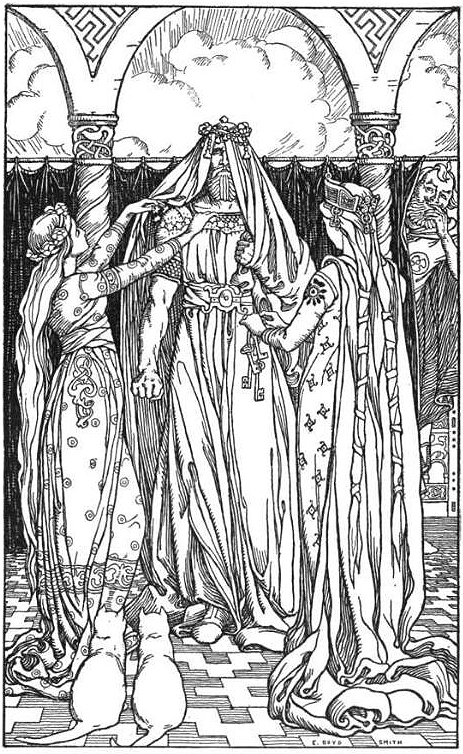
Barring some, probably unfair remarks that contemporary Goddess Spirituality just takes a male concept of deity and sticks it in a dress, there is a dearth of transvestite gods. Norse mythology, however, tends to be filled with an odd bunch of characters; one simply needs to recall the fact that Loki is the mother of Odin’s horse, to name but one example.
This myth is The Lay of Thrym (Þrymskviða), and held an enduring popularity in Scandinavia, continuing to be recited in several forms until the 19th century. It involves the story of the god Thor dressing as the goddess Freyja to retrieve his hammer from the giant Thrym. Here are two different translations. This one is longer and more poetic in style (remember the story was originally in poetic form), while this one is probably easier to read. I prefer the first, but that's just me. It is founf in the Poetic Edda.
There is little scholarly consensus on its age: some see it as an older heathen story, others as a Christian parody. I’m posting it because I find it interesting and wondered what you think of it. What message do you think it conveys? What image of, and attitude to, women does it project? Is the hammer symbolic of masculinity, and if so how is this reflected in the narrative? What questions does the story raise for you?
In all honesty, what I'm trying to work out is how Thrym didn't notice the beard. It's not as if the story takes place before the binding of Fenrir...
Monday, 6 October 2008
Saturday, 4 October 2008
Mystery Myths
There is a small prize going for the first person to identify which European nation's founding myths are portrayed in these images. Once you have discovered the country of origin, try and explain the significance of these myths in the nationalist discourse of the nation in question.
Myths
View SlideShare presentation or Upload your own.
Friday, 3 October 2008
Some thoughts about the storytelling
I was thinking about the myth that you have to re-tell.
When you'll do that, try to get the meaning of this exercise: its not about how well you know the story, nor on how well you tell it. It's just about how you tell it, what you include and what you exclude, what you stress and what you don't. It is about the elements of you that will lie in it. This means that you should not write it being concerned with the marking; do not sit down with a printed copy of the myth on one side and just rephrase it, the point would be completely missed.
In fact, what I would suggest is: read it as soon as possible, maybe twice, and then just let it be for some weeks. When the day will come for you to sit down and write it (or paint it, or facebook it, or sing it, or powerpoint it, or put it down in verses or whatever mean you can imagine...and the mean of course is instrumental to the goal, be aware) don't read it again, and what you will remember more vividly will constitute your own way of metabolizing it.
Once again, the assessment is more for your partecipation rather than for your accurate and detailed description of the myth. As every myth, it has a precise pattern: once you have understood it, after your first thorough reading, feel free to move within that pattern.
Just find a way to have fun with it.
(Of course, if you end up telling the story of Little Red Riding Hood, something has gone terribly wrong, or else your brain has a rather peculiar pattern of associations)
I hope you see my point (I tend to be right).
When you'll do that, try to get the meaning of this exercise: its not about how well you know the story, nor on how well you tell it. It's just about how you tell it, what you include and what you exclude, what you stress and what you don't. It is about the elements of you that will lie in it. This means that you should not write it being concerned with the marking; do not sit down with a printed copy of the myth on one side and just rephrase it, the point would be completely missed.
In fact, what I would suggest is: read it as soon as possible, maybe twice, and then just let it be for some weeks. When the day will come for you to sit down and write it (or paint it, or facebook it, or sing it, or powerpoint it, or put it down in verses or whatever mean you can imagine...and the mean of course is instrumental to the goal, be aware) don't read it again, and what you will remember more vividly will constitute your own way of metabolizing it.
Once again, the assessment is more for your partecipation rather than for your accurate and detailed description of the myth. As every myth, it has a precise pattern: once you have understood it, after your first thorough reading, feel free to move within that pattern.
Just find a way to have fun with it.
(Of course, if you end up telling the story of Little Red Riding Hood, something has gone terribly wrong, or else your brain has a rather peculiar pattern of associations)
I hope you see my point (I tend to be right).
Thursday, 2 October 2008
Next Week's Readings
The studypacks seem to be late, therefore you'll find the 2 articles that you have to read for next Thursday on the noticeboard outside Sian's door (339), in clearly marked paper folders. Please, just take one copy of each.
To remind you, the guide questions will be:
If you have any terrible uncertainty about them, feel free to post a comment below here and ask.
To remind you, the guide questions will be:
Both McCutcheon and Schöpflin draw attention to the way in which myth functions as a tool for self-definition and for constructing communal cohesion. What implications does this have for expanding the ways in which myth is conventionally theorised? Does the category myth need to be retheorised as McCutcheon suggests? Using McCutcheon’s and Schöpflin’s schemas, what kinds of narratives can you think of that might be understood as forms of ‘myth’ or ‘mythmaking’?
If you have any terrible uncertainty about them, feel free to post a comment below here and ask.
Subscribe to:
Posts (Atom)
